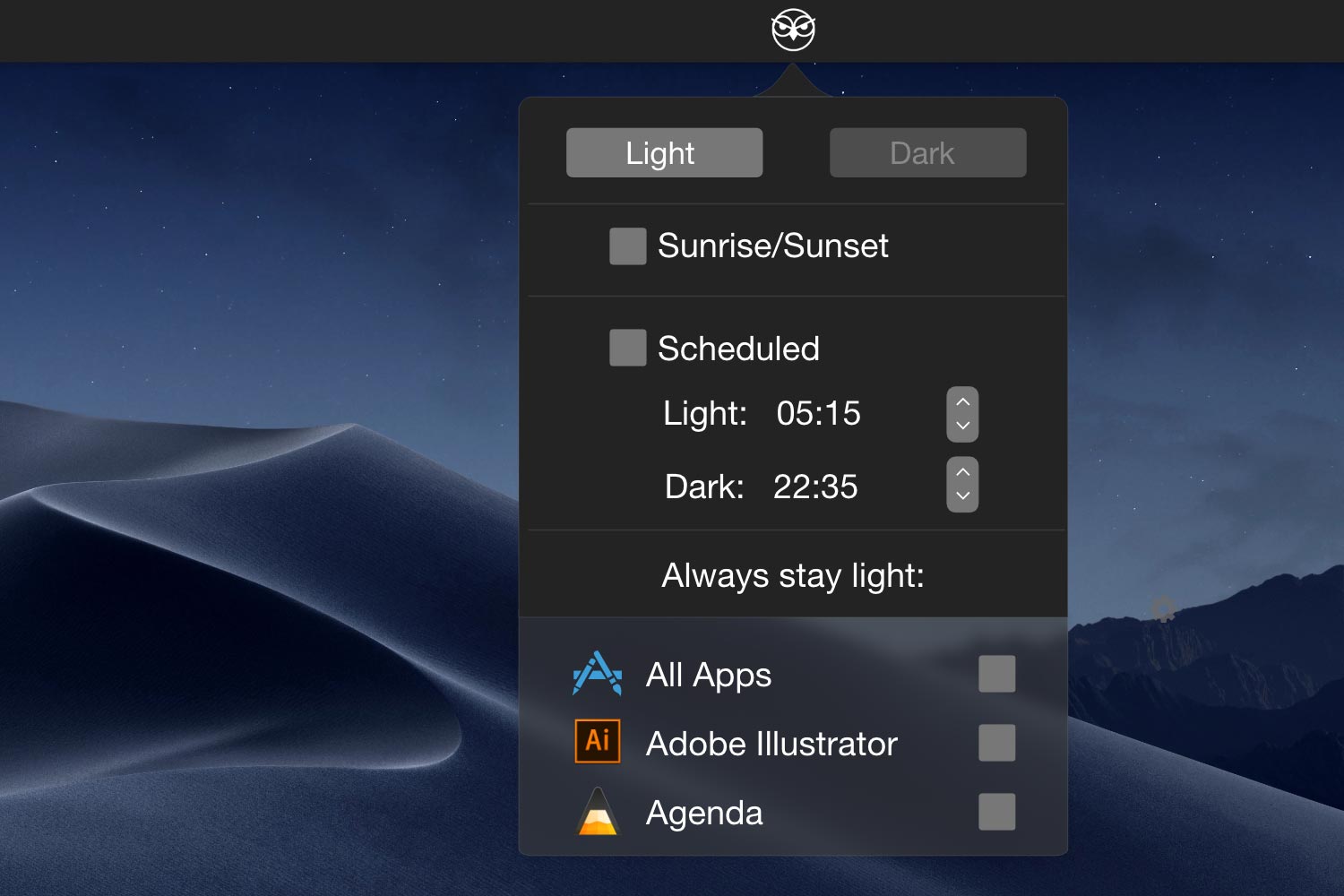
NightOwl will toggle the Dark/Light Modes based on your chosen time. You only have to set it up once, then it will run in the background.
Want your Mac to be in Dark Mode during night and switched back to Light Mode, when the sun rises? NightOwl does the work for you.
It only takes you a second to switch between Mojaves Dark/Light Modes by using the Hotkeys. Press, "Huuhuuhhh", dark. - that easy



NightOwl allows you to easily manage which of your Apps should stay light, while
your system runs in Dark Mode.
It's a really neat way to stop yourself from constantly switching between Dark
and Light Mode and stay better focused on your work in Dark Mode.
You can master Dark Mode per App and choose which mode works best for you.
Missing the Dark Dock and Menu Bar from earlier MacOs versions? - NightOwl
brings it back with just a single click.
From the forgotten history of Betty Boop's poodle ears to the digital streams of Inugami Korone and the real-life performances of Meow Dalyn, the "animal dog girl" has proven to be one of the most resilient and adaptable characters in entertainment and popular media. She can be a in a visual novel, a gritty anti-heroine in a graphic novel, a source of comfort for a lonely gamer, or a transgressive identity in an online subculture.
Gacha games like Arknights , Blue Archive , and Princess Connect! Re:Dive have monetized this ruthlessly. A new "Limited Dog Girl" unit (e.g., in Arknights , who literally sniffs the player) generates millions in revenue. The players aren't paying for stats; they are paying for an interactive companion simulation.
From the loyal wolfish companions in ancient folklore to the hyper-popular Kemonomimi (animal-eared characters) dominating anime conventions and the explosive rise of V-Tubers, the "dog girl" has become a cornerstone of modern entertainment. But why does this specific blend of human and canine resonate so deeply across different cultures and media formats? animal xxx dog girl full
As media continues to fragment and personalize, the demand for characters that offer simple, positive emotional feedback loops—characters who will always be happy to see you—will only grow. The Dog Girl, with her ever-wagging tail and bright, eager eyes, is perfectly positioned to lead that pack into the future. She is, and will likely remain, man's (and popular media's) best friend.
While the modern "Dog Girl" seems painfully contemporary, her roots lie in global folklore. In Japanese mythology, the Kitsune (fox women) and Inugami (dog spirits) were shapeshifters who could take female form. In European fairy tales, the loyal hunting hound often serves as a witch's familiar with a human soul. However, the visual codification of the Dog Girl happened in two places: 20th-century animation and 1990s eroge (erotic games). From the forgotten history of Betty Boop's poodle
The inherent loyalty associated with dogs translates perfectly into building a dedicated, tight-knit digital community (often referred to as a "pack").
What is the of your article (e.g., an academic cultural analysis, a pop-culture blog post, or a gaming trend report)? Re:Dive have monetized this ruthlessly
Talent agencies like Hololive and Nijisanji, alongside independent creators, frequently adopt canine avatars. Characters like Inugami Korone achieved global fame, blending a dog-like aesthetic with high-energy gaming streams.
The modern Dog Girl didn't appear out of thin air. She is a descendant of millennia of shape-shifting lore.
In modern Japanese entertainment, characters with animal ears and tails are known as kemonomimi . The subcategory of dog girls ( inumimi ) emerged as a way to project the universally loved traits of domesticated dogs onto human characters. Key Archetypes in Popular Media
141k +
27k+
6.3M +