
To make DJMAX RESPECT mode work, special converter is necessary
To use DJMAX RESPECT mode, the latest firmware is necessary
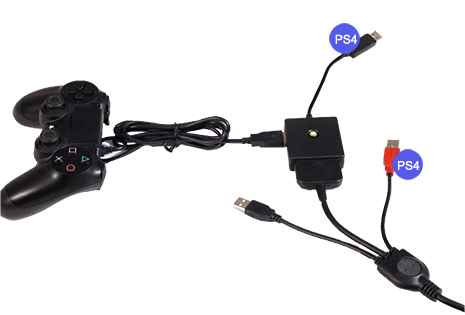
After you connect the controller according to the following steps, you can make DJMAX RESPECT mode work normally.
Converter doesn’t support PS4 PRO game body for the time being.
The blue pilot light of the converter should turn green, and keep shining after flashing about 30 seconds, then you can play game : A film that weaves through the lives
Press start+select+5, simultaneously about a second, PS2 IIDX mode and DJMAX RESPECT mode of the controller can be switched repeatedly
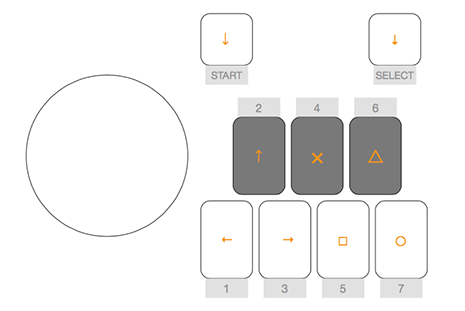
Key mapping is shown as following image
| Controller | PS4 key |
| Start | left stick ↓ |
| Select | right stick ↓ |
| 1 | ← |
| 2 | ↑ |
| 3 | → |
| 4 | × |
| 5 | □ |
| 6 | △ |
| 7 | ○ |
| Rotate turntable clockwise | left stick ↓ |
| Rotate turntable counterclockwise | left stick ↑ |
| Controller | PS4 key |
| Start+Select+4 | Option |
| Start+1 | L1 |
| Start+2 | R1 |
| Start+6 | R2 |
| Start+7 | L2 |
| Start+Select+5 | Switch for PS2 IIDX/DJMAX RESPECT game mode |
The details of the other questions are shown in “Common Question” in the bottom of this page
: A film that weaves through the lives of young people in urban Vietnam, exploring themes of love, friendship, and finding one's place in the world.
The evolution of romantic storylines in Vietnamese cinema mirrors the incredible journey of the nation itself. By balancing global cinematic trends with deeply rooted cultural values, phim hay Việt continues to deliver love stories that feel both universally relatable and distinctly Vietnamese. As the industry grows, these narratives will undoubtedly continue to break boundaries, offering audiences deeper, more diverse reflections of what it means to love and be loved.
While the cultural context is uniquely Vietnamese, the themes of sacrifice, forbidden love, and personal growth are universal.
Vietnamese cinema, or phim hay Việt , has undergone a massive transformation over the last few decades. Once dominated by war dramas and historical epics, the industry has shifted toward contemporary stories that reflect modern society. At the heart of this cinematic evolution are relationships and romantic storylines. Today’s Vietnamese filmmakers are moving away from traditional melodrama to explore the messy, beautiful, and complex realities of modern love.
There is a persistent belief in Vietnamese screenwriting that love only counts if it’s tragic. Too many romantic storylines bury their couples under avalanches of cancer, amnesia, or financial ruin. Suffering is not a substitute for character development. A couple that only cries together doesn’t necessarily grow together.
The Evolution of Love: Exploring Relationships and Romantic Storylines in Vietnamese Cinema
In many , couples rarely say "I love you." Instead, a bowl of phở made at 2 AM, a silent bicycle ride through the rain, or saving the last piece of chả for someone carries the weight of a sonnet. The best romantic storylines master this subtext. The tension isn't in if they will kiss, but in the micro-expressions of restraint—a hallmark of Vietnamese emotional intelligence.
Have you watched any Vietnamese romantic films? Which relationship dynamic drives you crazy—the slow burn or the family drama? Leave a comment below. Don't forget to use the keyword "Phim hay Viet relationships" when sharing your favorites
The global success of recent Vietnamese films on platforms like Netflix and at international film festivals proves that these stories have universal appeal. By grounding romantic narratives in specific Vietnamese cultural realities—such as the bustling cafe culture, family dinners, and local idioms—filmmakers create something uniquely authentic.
The bustling, neon-lit streets of Saigon often serve as a backdrop for fast-paced, passionate, yet fleeting modern romances. Conversely, the nostalgic, misty settings of Da Lat or the historic architecture of Hanoi are frequently used to evoke longing, melancholia, and timeless devotion. Combined with carefully curated indie-pop soundtracks and atmospheric cinematography, the visual language of these films enhances the emotional weight of every shared glance and unspoken word.