Originally written: 3/14/2012; last Web page update: 3/13/2020, referencing rEFInd 0.12.0
This Web page is provided free of charge and with no annoying outside ads; however, I did take time to prepare it, and Web hosting does cost money. If you find this Web page useful, please consider making a small donation to help keep this site up and running. Thanks!
| Donate $1.00 | Donate $2.50 | Donate $5.00 | Donate $10.00 | Donate $20.00 | Donate another value |
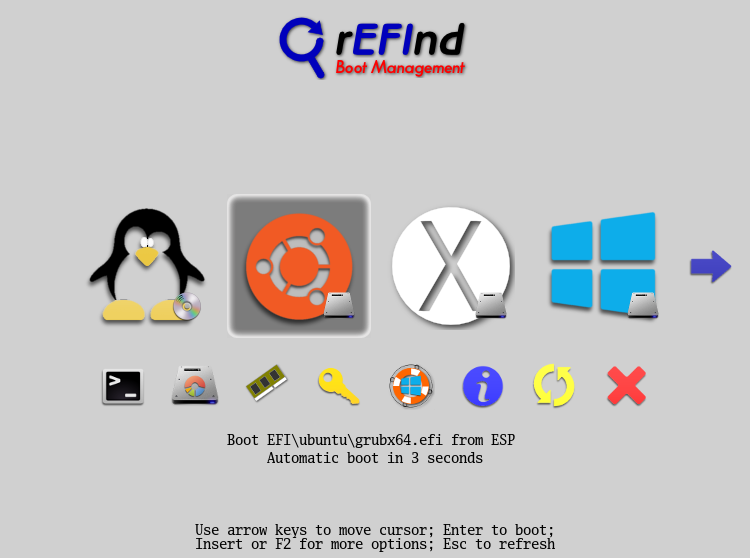
This page describes rEFInd, my fork of the rEFIt boot manager for computers based on the Extensible Firmware Interface (EFI) and Unified EFI (UEFI). Like rEFIt, rEFInd is a boot manager, meaning that it presents a menu of options to the user when the computer first starts up, as shown below. rEFInd is not a boot loader, which is a program that loads an OS kernel and hands off control to it. (Since version 3.3.0, the Linux kernel has included a built-in boot loader, though, so this distinction is rather artificial these days, at least for Linux.) Many popular boot managers, such as the Grand Unified Bootloader (GRUB), are also boot loaders, which can blur the distinction in many users' minds. All EFI-capable OSes include boot loaders, so this limitation isn't a problem. If you're using Linux, you should be aware that several EFI boot loaders are available, so choosing between them can be a challenge. In fact, the Linux kernel can function as an EFI boot loader for itself, which gives rEFInd characteristics similar to a boot loader for Linux. See my Web page on this topic for more information.
Months passed. The seed-swap service sprouted users: urban gardeners trading radish tips and late-night baking rituals. The Catalog Service grew an entire taxonomy of seeds, annotated with planting depth and folklore. The Inventory Service learned to factor in seasons. During an unexpected heatwave, the Metrics service she’d instrumented alerted on soaring request latencies. Autoscaling rules kicked in; new instances spun up like volunteers arriving at a neighborhood garden.
The book transitions away from older Netflix OSS components (like Zuul and Ribbon) which entered maintenance mode. It replaces them with modern, first-class Spring Cloud alternatives.
Instead of looking for a static PDF, you can engage with the material dynamically through these official and community-maintained GitHub repositories: spring microservices in action second edition pdf github
Navigating Cloud-Native Development with Spring Microservices in Action, Second Edition
Visualizing latency and tracking bottlenecks across service boundaries. Maximizing the Official GitHub Repository Months passed
: Preventing a single failing service from cascading across the network.
: For those looking for specific 2021 edition notes, the magadiflo repository offers additional structured documentation. 2. Accessing the PDF Legally The Inventory Service learned to factor in seasons
To get the most out of the book's practical exercises, follow this standard workflow to launch the sample application ecosystem. 1. Clone and Navigate
The official code is typically hosted under the repository name or via Manning's official organizational GitHub page.
copyright © 2012–2020 by Roderick W. Smith
This document is licensed under the terms of the GNU Free Documentation License (FDL), version 1.3.
If you have problems with or comments about this Web page, please e-mail me at Thanks.
Return to my main Web page.